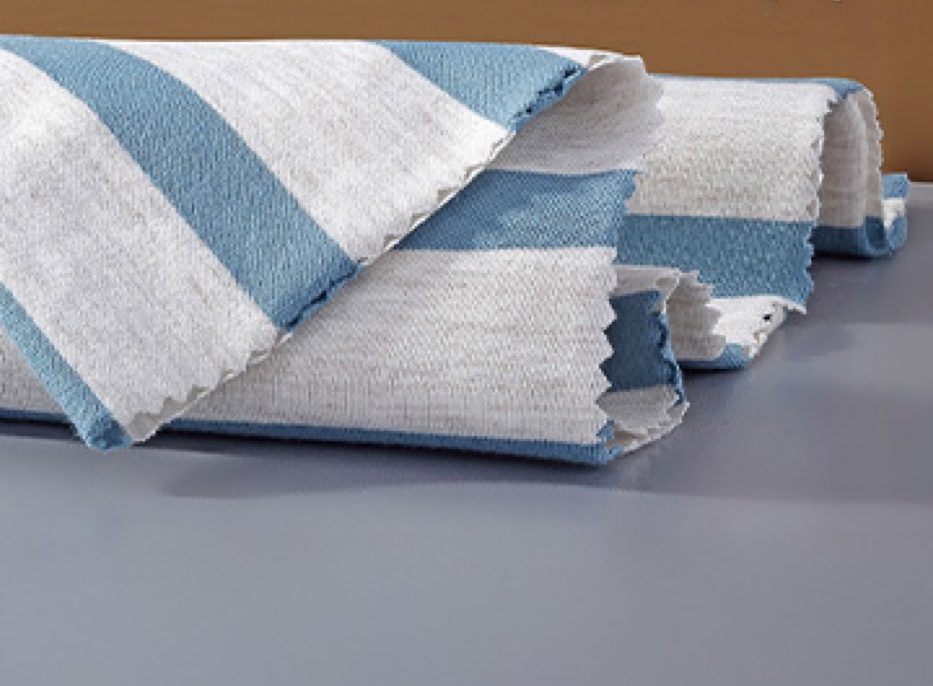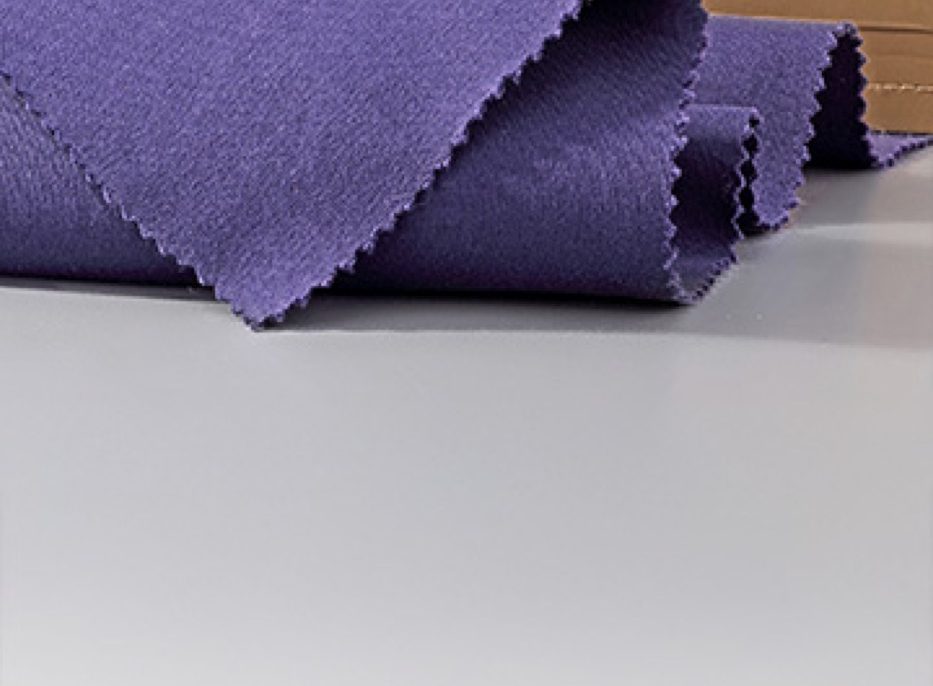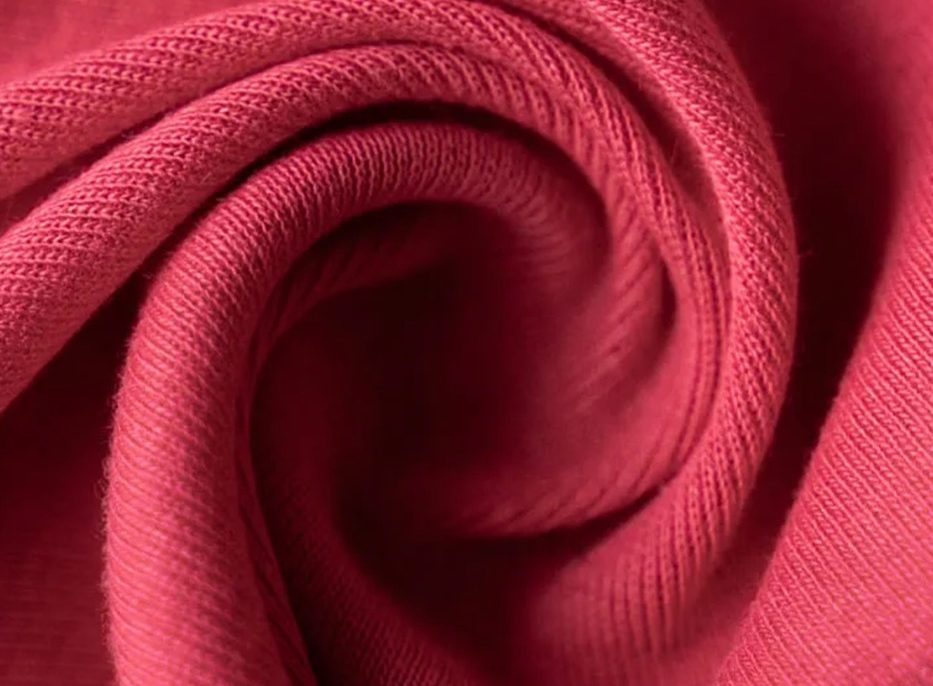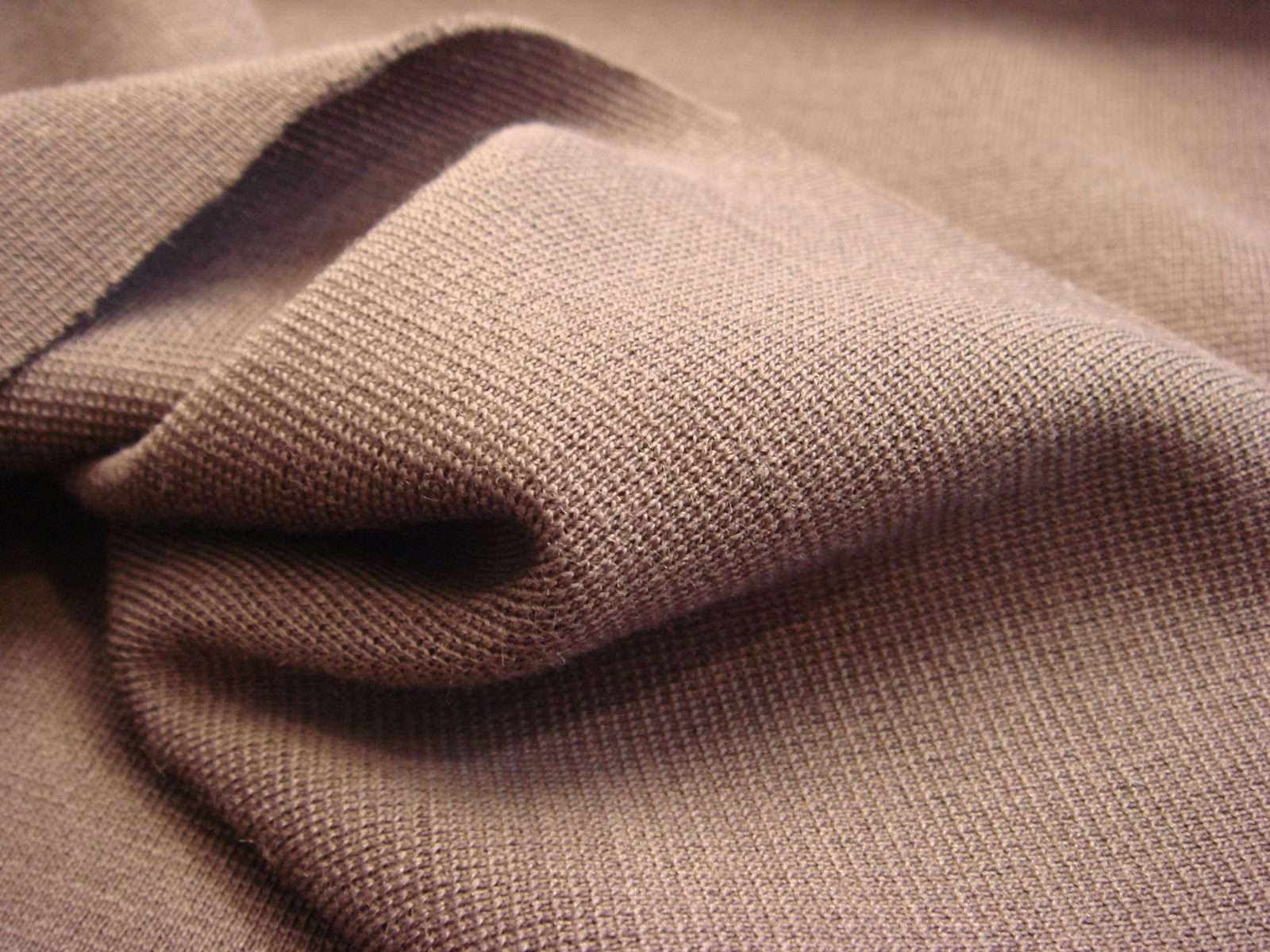
Single jersey, interlock and rib are the three names you meet most often in a knitted fabric catalogue. All three belong to the weft knitting family, can frequently be produced from the same yarn, and may look similar at first glance. Their constructions are different, however, and that difference decides how the fabric stretches, how thick it feels, how the cut edge behaves and which product it suits.
Single jersey: the basic single-bed structure
Single jersey is knitted on one needle bed. The face shows flat vertical wales and the back shows horizontal loops, so the two sides differ. It is light, drapes well and is economical to produce, which makes it the main t-shirt fabric.
Its best known weakness is edge curling: a raw cut edge rolls inwards. A single-bed structure also means lower dimensional stability, so shrinkage after washing is watched closely. T-shirt single jersey is usually worked between 140 and 200 g/m².
Rib: vertical channels with crosswise stretch
Rib is formed by alternating face and back wales. Vertical channels appear on the surface and both sides look similar. Its defining property is high crosswise stretch combined with good recovery.
That behaviour makes rib ideal for collars, cuffs, waistbands and any part that has to hug the body. It is produced in repeats such as 1x1 or 2x2, and does not curl at the edge. Cashcorse can be seen as a fuller, heavier variation used as a body fabric.
Interlock: the stable double-bed surface
Interlock is obtained by interlacing two rib structures. Both faces look flat and similar to the face of single jersey, so the fabric can be used either way round. The double-bed construction makes it fuller, more opaque and dimensionally more stable.
With the same yarn, interlock gives a heavier fabric than single jersey and usually sits between 180 and 260 g/m². It does not curl, offers an even ground for printing and feels soft against the skin, which suits underwear, babywear and premium basics. Because more yarn is needed, it costs more than single jersey.
A short comparison
- Construction: single jersey uses one bed, rib and interlock use two.
- Appearance: single jersey has two different faces, rib shows vertical channels, interlock is flat on both sides.
- Stretch: rib stretches most across the width, interlock is the most balanced, single jersey is the lightest and most fluid.
- Cut edge: single jersey curls, rib and interlock do not.
- Typical use: single jersey for t-shirts, rib for collars and cuffs, interlock for underwear and babywear.
Which one for which product?
A light summer t-shirt starts with single jersey, while its collar and cuffs are most likely rib, because they have to stretch and recover. For baby bodysuits and underwear, where softness and shape retention come first, interlock stands out. Polo shirts classically use piqué, though interlock is an option when a closer, smoother surface is wanted.
The construction name alone is not enough, though. Two fabrics both called single jersey can behave completely differently depending on yarn count and stitch density, and finishing changes surface lustre and shrinkage. So alongside the construction, describe your target weight, width, composition and washing expectations.
The basics are covered in what is knitted fabric, and the weight and width decision in a separate guide.
At Tutku Fabric this comparison does not stay on paper. We propose the construction that matches your product, make the decision tangible with swatches and samples, and follow weight and width checks on our production partner's line. If you are not sure which structure fits, send us your product type and target hand feel through the quote form and we will review the closest alternatives together.
Next step
Shall we develop the right fabric for your product?
Share your target weight, width and end use; we will get back with suitable constructions and sample options.
Request sample / quote ↗